The EU icons for identifying AI-generated content
How the EU icons for AI-generated content work: the three official variants, where to apply them, and how they fit the EU AI Act.
The European Union has put together a common set of icons so people can tell when an image, a video, an audio clip or certain kinds of text have been generated or modified using artificial intelligence.
These icons are part of the Code of Practice on Transparency of AI-Generated Content, and they make it easier to comply with Article 50 of the EU AI Act. Using the icons themselves is voluntary — the obligation to inform the public is not. That obligation has applied since 2 August 2026, wherever content falls within the scope of the rules.
Which content needs a visible disclosure?
The obligation doesn’t cover every piece of content an AI had a hand in. It applies mainly to:
- Images, video and audio that constitute deepfakes: content that realistically depicts people, objects, places, entities or events in a way that could be mistaken for genuine.
- Text generated or manipulated with AI and published to inform the public on matters of public interest, where it hasn’t had substantive human review or effective editorial control, with someone taking responsibility for what’s published.
Flexibility for artistic, satirical and fictional work
Works that are clearly artistic, creative, satirical or fictional are held to a more flexible transparency standard — one that shouldn’t get in the way of how the work is experienced.
The three official EU icon variants
Within the Code of Practice on marking and labelling AI-generated content, the EU sets out three functional variants:
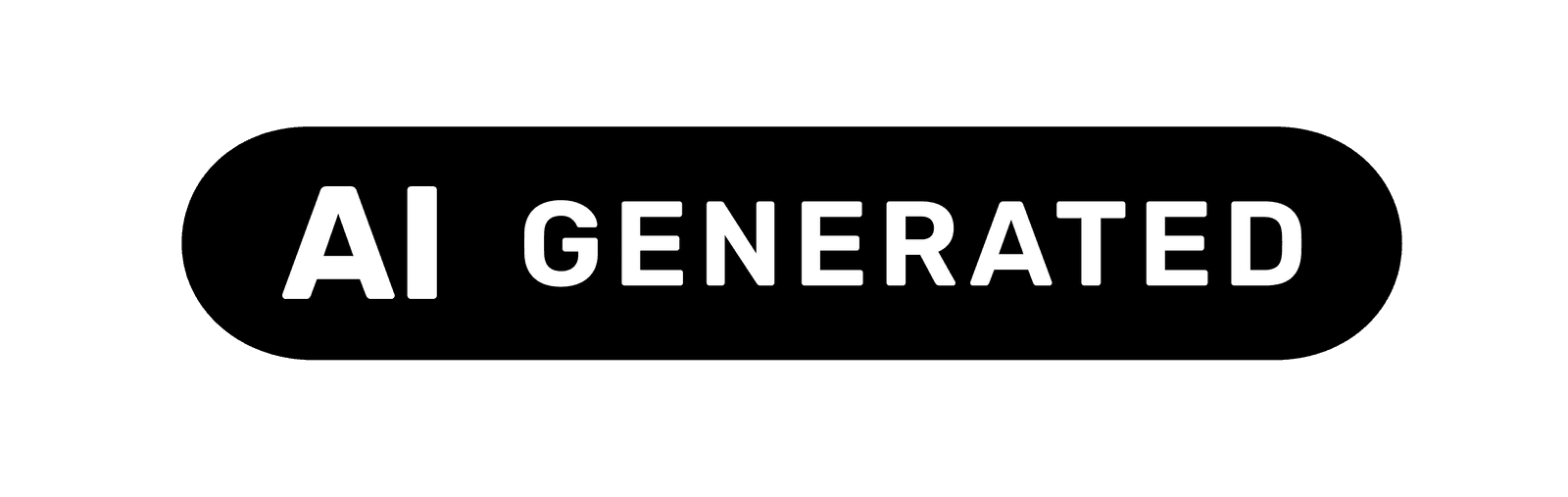
Basic icon. Signals that AI was involved in creating or modifying the content. It can come with a more specific explanation, such as “AI-generated voice”, or link through to a second layer of information.
Fully generated with AI. Used when the entire piece was produced artificially, with no human-created elements and no human editorial input beyond entering instructions or prompts.
Partially modified with AI. Applies when existing human content has been altered with AI to the point of becoming a deepfake, or otherwise falls under the labelling obligation — swapping a face in a photograph, say, or digitally furnishing an empty room in a real property listing.
The icons come in black, white, and versions with 50% transparency, so they work across different backgrounds and formats.
Design, visibility and complementary technical marking
The icon needs to be noticeable from the moment someone first encounters the content, large enough to read clearly, and placed somewhere other elements won’t cover it.
It should also stay attached to the piece when it’s shared or downloaded, unless the platform offers an equivalent way of preserving that information. Explanatory text should use plain language and, where possible, be accessible through alt text or assistive technologies.
Download links for the icons:
SVG format: https://ec.europa.eu/newsroom/dae/redirection/document/129546
PNG format: https://ec.europa.eu/newsroom/dae/redirection/document/129547
Each icon comes in four versions: black, white, black at 50% transparency, and white at 50% transparency.
A visible icon isn’t a substitute for machine-readable technical marking. The two work as complementary layers: one speaks to people directly, the other lets platforms and systems detect where a file came from.
How does VeriqX connect visible labels to file-level traceability?
VeriqX will shortly add these visible icons to certified content where relevant. Each label will be linked to the information documented during production: tools, models, prompts, input files, modifications and human involvement.
That evidence is, in turn, bound to the final file through a certificate, timestamping and provenance standards such as C2PA / Content Credentials.
Showing the icon is only half the point. The other half is being able to explain what it means, why it was applied, and what process sits behind it.
Key points and frequently asked questions about the EU icons and AI
Is it mandatory to use the official EU icons to mark AI content?
Using the graphics themselves is voluntary, but the obligation to inform the public about deepfakes or unreviewed text has applied since 2 August 2026.
What do the three EU icon variants mean?
They show whether AI was involved in general terms, whether the piece was fully generated without human control, or whether real content was partially modified.
Does a visible icon replace technical marking in the file?
No. The icon informs the human viewer, while technical marking such as C2PA lets platforms and systems detect the file’s provenance automatically.
Need to apply the icons and connect them to the traceability the EU AI Act requires?
- Technical consultancy and corporate certification: [email protected]
- Talk to the author directly (David Lahoz): https://www.linkedin.com/in/dlahoz/
Certify your content with VeriqX
Document how each file was made, seal it with C2PA Content Credentials and share a certificate anyone can verify.
Certify your first file for freeRelated articles

What the EU AI Act means for AI content production
How the EU AI Act affects AI content production: the Article 50 rules on machine-readable marking, visible labelling and deepfakes.
- EU AI Act
- Labelling
- Production
How to get your company ready for the EU AI Act: a compliance checklist
An EU AI Act compliance checklist for companies: audit your tools, train your teams and document how you use AI in line with the 2026 rules.
- EU AI Act
- Governance
- Business

How to document and certify AI-generated content, step by step
A 2026 step-by-step guide to documenting and certifying AI-generated content under the EU AI Act — build your evidence trail before you need it.
- EU AI Act
- Certification
- C2PA